
Sheet Metal
How does the Sheet Metal Fabrication Process Work?
Design & Material Selection
Before any cutting or forming begins, the part or product is designed (often with CAD/3D modeling), including dimensions, bend lines, hole positions, and tolerances.
Based on application requirements (strength, corrosion resistance, finish, budget, usage environment), the appropriate sheet-metal material is selected (e.g., stainless steel, carbon steel, aluminum, etc.).
Cutting
The raw metal sheet is cut to the required 2D shapes or “blanks.” Cutting methods vary depending on thickness, precision, and material: common techniques include laser cutting, water-jet cutting, plasma cutting, and shearing.
This step defines the outline of each part that will later be bent, formed, or assembled.
Punching
For parts that need holes, slots, cutouts, or special edge shapes, punching or notching may be applied to the blanks before forming. This helps create features like vents, mounting holes, slots, or flanges.
For mass production or repetitive patterns, stamping or blanking can be used.
Bending
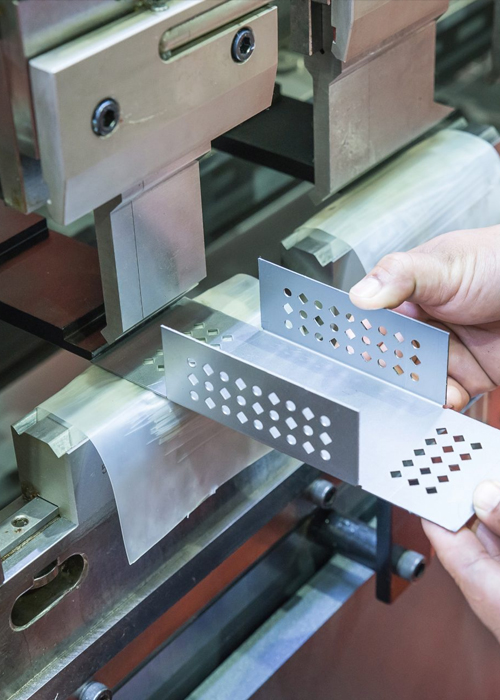
The flat blanks are then shaped into 3D forms. This can involve bending (e.g., with press brakes), rolling (for curves or cylinder shapes), stamping, deep-drawing, or other forming processes, depending on the geometry.
Prope planning is important: bend sequences, grain direction (for metals with grain), bend radius, and tool selection all affect whether the final part meets design specs or cracks/distorts.
Assembly / Joining
If the final product requires multiple sheet-metal parts, they must be joined by Luckson. Common joining methods include welding (MIG, TIG, spot welding), riveting, bolting, or mechanical fasteners, depending on requirements.
Welding is often used for permanent, strong joins; bolts/rivets or fasteners may be used when disassembly or modular assembly is needed.
Finishing (Surface Treatment & Final Touches)
After shaping and joining, parts are often finished to improve appearance, durability, and functionality. Finishing may include deburring (removing sharp edges or burrs), grinding/sanding weld seams, polishing, painting, powder coating, anodizing, or other surface treatments.
This step is especially important when the metal part will be exposed (architectural features, railings, furniture, visible surfaces) or used in harsh environments (corrosion resistance, hygiene, long-term durability).
Quality Inspection & Final Assembly / Packaging
Once fabrication and finishing are complete, each piece undergoes inspection: checking dimensions, weld quality, surface finish, fit-up of assemblies, and compliance with design specifications.
Finally, the product may be assembled with other components (if part of a larger structure), packaged, and prepared for delivery or installation.
Project Details
- Category: Sheet Metal
- Date: 2026年2月7日
-
Summary:
Sheet metal processing is a comprehensive cold processing technology for thin metal sheets (stainless steel sheets, aluminum sheets, etc., usually less than 6mm), including cutting, stamping, bending, welding and surface treatment, to process them into the metal structures or products you want.
Related Projects
Subscribe To Newsletter
you can either fill project details in our "get a quote" form, or drop your email add. here and our sales will contact you in 24 hours.

Shenzhen Luckson Precision Co., Ltd 520, Block E, Fuhai Wenchuang, Fuyong Town, Bao'an, Shenzhen Email: [email protected] Phone: +86 19820814286
Our Company
Our Services
Contact
Copyright © 2026 All rights reserved