
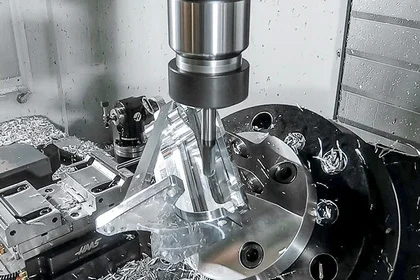
CNC (Computer Numerical Control) milling is a subtractive manufacturing process that combines traditional milling techniques with computer control. It involves using a rotating cutting tool to remove material from a solid block of metal, plastic, wood, or other materials to create precise parts and products.
How Does CNC Milling Work?
Design Creation: The process begins with creating a CAD (Computer-Aided Design) model of the desired component. This model is then converted into machine-readable instructions using CAM (Computer-Aided Manufacturing) software, generating G-code.
Setup: The workpiece is secured to the machine bed, and the appropriate cutting tools are mounted on the spindle. The CNC program is loaded to initiate the milling process.
Machining Process: The CNC milling machine executes the programmed instructions, moving the cutting tool along multiple axes to remove material and shape the workpiece. The complexity of the operation can vary based on the type of CNC milling machine used, with options ranging from simple 3-axis machines to advanced 5-axis models.
Types of CNC Milling Machines
3-Axis Milling Machines: These are the most common and allow movement along the X, Y, and Z axes, suitable for simple parts with straightforward geometries.
4-Axis Milling Machines: In addition to the three axes, these machines can rotate the workpiece, allowing for more complex cuts around cylindrical shapes.
5-Axis Milling Machines: These machines provide the highest level of complexity, allowing for movement along three linear axes and rotation of the tool head, enabling the production of intricate parts with complex geometries.
2 Sources
Applications of CNC Milling
CNC milling is widely used across various industries, including:
Aerospace: For producing lightweight and complex components.
Automotive: In manufacturing parts with high precision and durability.
Electronics: For creating intricate circuit boards and housings.
Medical: In the production of surgical instruments and implants.
Advantages of CNC Milling
Precision and Accuracy: CNC milling machines can achieve tolerances as tight as +/- 0.001 inches, making them ideal for high-precision applications.
Automation: The automated nature of CNC milling reduces human error and increases production efficiency.
Versatility: CNC milling can work with a wide range of materials, including metals, plastics, and composites, allowing for diverse applications.
In summary, CNC milling is a vital manufacturing process that leverages advanced technology to produce high-quality, precise components across various industries. Its ability to automate and control the machining process makes it a preferred choice for modern manufacturing.