
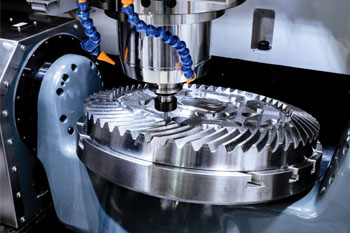
CNC milling uses a rotating cutting tool to remove material from a stationary workpiece. The material stays in place, and the tool moves across it, shaving off what you don’t need. It’s precise and controlled, kind of like carving—but with software doing the thinking and a spinning bit doing the work.
There are mainly 3 types milling machines:
• 3-axis milling, which moves in straight lines across X, Y, and Z
• 4-axis, which adds rotation
• Or 5-axis, which can tilt and rotate for more complex angles
The more axes you use, the more freedom you get to machine tight corners, steep angles, and smooth contours in a single setup.
CNC milling works well for:
• Flat surfaces
• Pockets and slots
• Curved or angled features
• Holes and tapped threads
• Materials like aluminum, steel, brass, and plastics
• Tasks like prototypes, short-run production, and custom designs
Limitations of CNC milling:
• Not ideal for round parts, like shafts or pins—CNC turning is more efficient
• Setup can be time-consuming, especially if the part needs custom fixtures
• Small batch jobs may cost more, due to the extra work needed to prepare each setup

test